January 2026 Brings the Most Exciting Car Launches in Years
The automotive industry is kicking off 2026 with unprecedented momentum. January promises to be one of the most action-packed months in recent memory, with manufacturers across segments unveiling vehicles that could reshape buyer preferences for years to come. From affordable family MPVs to next-generation SUVs and India's first mainstream electric offerings, the upcoming car models january 2026 lineup represents a genuine transformation in what's available to buyers.
This isn't just about incremental updates or facelifts. We're talking complete redesigns, segment-defining electrification, and technology packages that were premium luxuries just a year ago becoming mainstream expectations. Whether you're planning a purchase in Q1 2026 or simply keeping tabs on market trends, understanding what's launching this month is essential.
India's January 2026 Launch Calendar
The Indian market dominates the January launch schedule, with manufacturers timing major reveals to coincide with the pre-budget period and the approaching financial year-end.
Kia Seltos Second Generation (January 2, 2026)
Kia is wasting no time getting 2026 started, with the completely redesigned Seltos launching on the very first working day of the year. Unveiled in December 2025, the second-generation model represents a dramatic departure from its predecessor's design language.
The new Seltos adopts a more upright, commanding stance with vertical LED daytime running lights that give it instant recognition. It's grown in every dimension, translating to genuinely improved interior space—a key consideration for families who found the outgoing model's rear seat adequate but not exceptional.
Inside, the transformation is even more dramatic. The trinity panoramic display borrowed from the Syros—combining a digital instrument cluster, central touchscreen, and front passenger display into one seamless unit—elevates the cabin ambiance significantly. Material quality has improved across the board, addressing one of the few genuine criticisms leveled at the original.
Powertrain options carry over from the outgoing model: the 1.5-liter naturally aspirated petrol (115 hp), 1.5-liter turbo-petrol (160 hp), and 1.5-liter diesel (116 hp). However, the naturally aspirated engine is expected to receive hybrid assistance by 2027, positioning it to compete directly with the Maruti Grand Vitara and Toyota Urban Cruiser Hyryder.
Expected pricing sits between ₹12 lakh and ₹22 lakh, maintaining the Seltos's position as a premium but accessible mid-size SUV. Given the original's success—consistently ranking among India's top-selling SUVs—the new model should capture even stronger market share.
Mahindra XUV 7XO (January 5, 2026)
Mahindra is giving its successful XUV700 a comprehensive mid-cycle refresh, and the name change to 7XO signals this is more than just new badging. The updated model debuts with a sharper front grille, redesigned LED lighting elements, and a more polished interior with better materials throughout.
The current XUV700's biggest strength—its powerful and refined engine options—remain unchanged. The 2.0-liter turbo-petrol and 2.2-liter diesel continue, but Mahindra has reportedly improved NVH (noise, vibration, and harshness) levels further. This was already a segment strength, so improvements here should be immediately noticeable.
Technology integration gets meaningful upgrades, with enhanced ADAS (Advanced Driver Assistance Systems) features and improved infotainment responsiveness. Mahindra learned from the XUV700's initial launch—when demand so dramatically exceeded supply that waiting periods stretched to months—and has prepared production capacity accordingly.
Pricing is expected to start around ₹13 lakh and extend beyond ₹26 lakh for fully-loaded variants. The 7XO competes in the brutally competitive mid-size SUV segment against the Tata Safari, MG Hector Plus, and Hyundai Alcazar, but Mahindra's strong brand equity in the SUV space gives it a natural advantage.
Nissan Gravite MPV (January 2026)
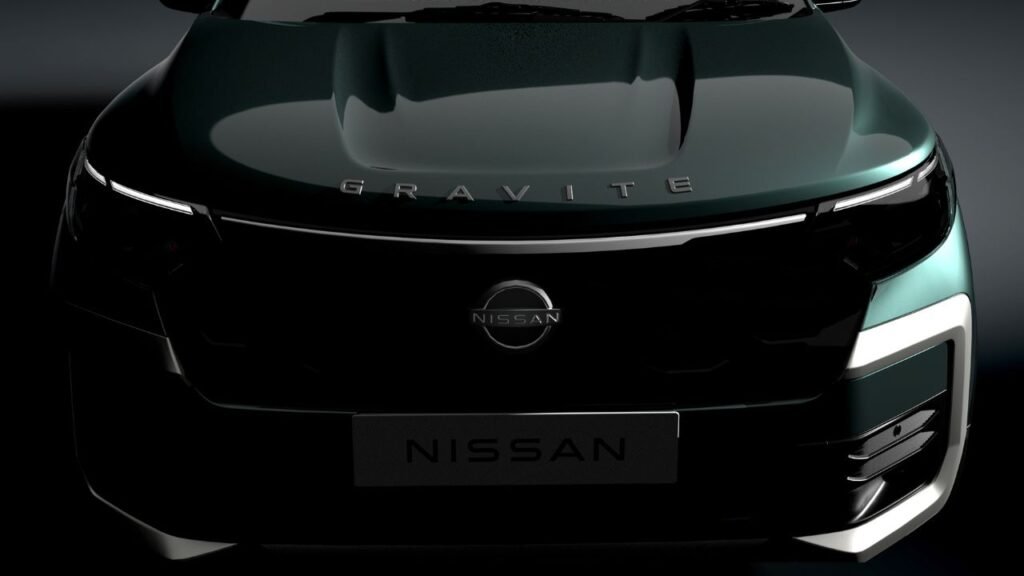
After years of struggling with just the Magnite in its lineup, Nissan finally has something new for Indian families. The Gravite represents Nissan's first proper MPV offering in the country, targeting buyers who need seven seats but can't justify the ₹10+ lakh entry point of most competitors.
Platform-sharing with the Renault Triber keeps costs down, but Nissan has worked hard to ensure the Gravite doesn't feel like a simple rebadge. The front fascia features Nissan's global design language with a prominent grille, LED lighting, and the distinctive 'GRAVITE' badging on the bonnet—a styling cue that will extend across Nissan's upcoming lineup.
The modular 2+3+2 seating configuration allows owners to remove the third row entirely for maximum cargo space, or use all seven seats when ferrying extended family. This flexibility is crucial in the Indian market where vehicles serve multiple roles.
Expected pricing between ₹6 lakh and ₹9 lakh positions the Gravite as India's most affordable seven-seater from a mainstream manufacturer. The 1.0-liter naturally aspirated petrol engine (72 hp) prioritizes efficiency over excitement, with both manual and AMT transmission options available.
For budget-conscious families upgrading from hatchbacks or first-time car buyers who need occasional seven-seat capacity, the Gravite addresses a genuine gap. Success here could finally give Nissan the volume seller it desperately needs to expand its dealer network.
Maruti eVitara (January 2026, Sales Begin March)
Maruti Suzuki's electric debut has been years in the making, and the eVitara represents the brand's biggest gamble in decades. As India's largest carmaker by volume, Maruti's entry into the EV space legitimizes electric mobility for millions of buyers who've been hesitant about the technology.
The eVitara offers two battery options: a 49 kWh pack delivering approximately 142-144 hp with 192 Nm torque, and a 61 kWh variant producing 172-174 hp with the same torque. Range figures hit an impressive 543 km for the larger battery on the WLTP cycle—genuinely competitive with petrol SUVs on a tank-to-charge basis.
Performance isn't sluggish either. The 49 kWh model hits 0-100 km/h in 9.6 seconds, while the 61 kWh version manages it in 8.7 seconds. These figures match or exceed many popular petrol SUVs, dispelling the myth that EVs are inherently slow.
Crucially, Maruti is offering battery-as-a-service (BaaS) options to reduce upfront costs—a potential game-changer for buyers concerned about the initial price premium. Expected pricing between ₹17 lakh and ₹22.5 lakh positions it competitively against the Tata Nexon EV, MG ZS EV, and Hyundai Kona Electric.
Maruti's 250 crore investment in charging infrastructure demonstrates commitment beyond just selling vehicles. The success or failure of the eVitara will significantly influence how quickly India's EV transition accelerates in the mass market.
Renault Duster (January 26, 2026)
Few nameplate returns generate as much anticipation as the Duster. The original transformed Renault's fortunes in India, proving that a rugged, affordable SUV with decent features could capture significant market share. The new generation, built on the CMF-B platform, promises to recapture that magic with thoroughly modern execution.
Global styling from the Dacia Duster translates beautifully, with muscular proportions and contemporary LED lighting creating road presence well beyond the price point. The interior represents a generational leap, with materials, fit, and finish that wouldn't look out of place in SUVs costing 50% more.
Level 2 ADAS, panoramic sunroof, 360-degree camera, and a large infotainment system with advanced smartphone connectivity address the feature gaps that hurt the previous-generation Duster in its later years. Indian buyers have become significantly more demanding about technology and convenience features—the new Duster delivers comprehensively.
Powertrain options include a 1.3-liter turbocharged petrol with dual-clutch transmission and a 1.2-liter turbocharged mild-hybrid petrol. The mild-hybrid system improves fuel efficiency without the complexity and cost of full hybrid technology, potentially offering the best balance for most buyers.
All-wheel drive will likely return as an option, maintaining the Duster's capability reputation even if most buyers never venture off-pavement. Expected pricing between ₹10 lakh and ₹20 lakh puts it squarely in competition with the Hyundai Creta, Kia Seltos, and a revitalized crop of mid-size SUVs.
Global Launches: Supercars Steal the Show
While India focuses on practical family vehicles and emerging electrification, the global stage in January 2026 belongs to high-performance machinery that pushes technical boundaries.
Toyota GR GT and Lexus LFA Concept
Toyota's December 2025 reveal of the GR GT and electric Lexus LFA Concept continues to generate buzz heading into January, with production versions expected to reach select Lexus dealerships in late 2026 or early 2027.
The GR GT represents Toyota's most ambitious performance project since the original LFA. Built on an all-aluminum spaceframe—Toyota's first—with carbon fiber body panels, it targets a weight below 1,750 kg (3,858 lbs), approximately 180 kg lighter than competitors like the Ferrari 12Cilindri.
Power comes from an all-new 4.0-liter twin-turbo V8 paired with a single electric motor, delivering at least 641 hp and 627 lb-ft of torque. The hybrid system isn't there primarily for efficiency—though that's a welcome benefit—but to fill torque gaps and provide instant response off the line.
With the engine positioned entirely behind the front axle centerline and a rear-mounted transaxle, weight distribution favors a rear bias (55/45), which should translate to agile handling characteristics. Carbon-ceramic brakes come standard, providing the stopping power to match the acceleration.
Pricing will benchmark against the Porsche 911 GT3 (around $230,000) and Mercedes-AMG GT (approximately $202,000), likely landing in the $200,000-$225,000 range. This positions it well below the original LFA's inflation-adjusted $530,000 price—a deliberate decision by Toyota Chairman Akio Toyoda, who regrets making the original LFA so limited and expensive that few could experience it.
The electric Lexus LFA Concept shares the GR GT's aluminum structure but replaces the hybrid V8 with electric motors. Details remain scarce, but expect pricing around $500,000 if it reaches production. The challenge for Lexus will be delivering an engaging driving experience without the visceral appeal of the original's howling V10 engine—something many EV sports cars struggle with.
Both vehicles serve strategic purposes beyond profit. They demonstrate Toyota and Lexus engineering capabilities, create halo effects that improve brand perception across their respective lineups, and provide technology test beds for systems that will eventually trickle down to mass-market models.
Ferrari's First EV (Spring 2026)
While not a January launch specifically, Ferrari's first-ever electric vehicle scheduled for spring 2026 represents one of the most significant developments in supercar history. The Italian marque has resisted full electrification longer than most premium brands, making this debut particularly significant.
Expected to take SUV form—pragmatic given market realities—the Ferrari EV will feature a quad-motor powertrain producing over 1,000 hp. Acceleration to 60 mph should happen in under 2.5 seconds, though in the world of performance EVs, that's merely meeting expectations rather than exceeding them.
The real question is whether Ferrari can make an EV engaging in the ways that define the brand: steering feel, chassis balance, that intangible connection between driver and machine. Ferrari has decades of experience making cars that feel special regardless of speed—translating that to electric propulsion is the challenge.
Pricing will likely exceed $300,000, possibly substantially if Ferrari includes cutting-edge battery technology. The brand has hinted at potentially using solid-state batteries, which would be a genuine technical milestone—though Toyota has missed multiple solid-state battery deadlines, so skepticism is warranted.
Honda Prelude (2026)
Honda is reviving another iconic nameplate with the 2026 Prelude, though this version takes a dramatically different approach than its predecessors. Instead of a naturally aspirated sports coupe, the new Prelude is a 2+2 hybrid sport coupe that prioritizes efficiency alongside engagement.
The powertrain comes straight from the Civic Hybrid: a 2.0-liter four-cylinder paired with electric motors producing a combined 200 hp. What makes it interesting is the addition of paddle shifters that simulate gear changes through the CVT—an attempt to provide engagement in an otherwise continuously-variable transmission.
Suspension design borrows from the Civic Type R, promising confident handling even if outright performance doesn't match hot hatch benchmarks. Honda's goal isn't to create a track weapon but rather a compelling daily driver that's enjoyable on back roads while remaining practical for commuting.
Interior design features aggressively bolstered front bucket seats and Honda's Google-built infotainment system with voice assistant and Google Maps integration. Importantly, physical controls for climate and audio remain—a welcome decision in an era where too many manufacturers bury everything in touchscreens.
The back seats, in traditional 2+2 fashion, will be best used for cargo or small children. This layout isn't a compromise—it's a deliberate choice that allows for better front seat positioning and a lower roofline without completely sacrificing rear passenger capability.
Expected pricing hasn't been announced, but positioning it above the Civic Hybrid ($32,000) but well below premium sports coupes seems likely. Figure on a $35,000-$40,000 range, competitive with the Mazda MX-5 RF and Subaru BRZ.
BMW iX3 and i3 Sedan (Summer 2026)
BMW's Neue Klasse platform finally reaches production in 2026, starting with the iX3 SUV followed by the i3 sedan. These models represent BMW's electric future, featuring completely redesigned interiors, 400+ miles of range, and charging architecture optimized for 800-volt DC fast charging.
The iX3 launches first in its top-spec form with 463 hp, targeting the performance end of the electric SUV market. The i3 sedan follows shortly after, borrowing the same underlying platform and battery technology while offering a more traditional three-box sedan profile.
BMW has confirmed the first electric M3 is coming, though it may arrive as a 2027 model. Rumors suggest a quad-motor configuration could deliver supercar-level performance—potentially over 700 hp—making it a genuine rival to the upcoming Tesla Model S Plaid refresh and Porsche Taycan Turbo S.
The regular 3-series isn't being abandoned. A heavy refresh arrives alongside the i3, bringing the combustion-powered sedan's styling in line with its electric sibling. This dual-track approach allows BMW to serve both EV adopters and buyers who aren't ready to make the switch.
Pricing for the iX3 starts around $60,000 in the US, with the i3 sedan likely commanding similar figures. These won't be volume sellers immediately, but they establish BMW's electric credentials in the critically important compact luxury segment.
What Makes January 2026 Different
Past Januarys have brought vehicle launches, but 2026 feels qualitatively different for several reasons.
Electrification Reaches Critical Mass
Electric vehicles transition from niche offerings to genuine mainstream options this month. Maruti's eVitara brings EV technology to India's largest automaker by volume, potentially influencing millions of purchase decisions. When the brand that defines mass-market automotive in India commits to EVs, it signals a tipping point.
Globally, BMW's Neue Klasse, Ferrari's first EV, and the electric Lexus LFA Concept demonstrate that electrification now spans every segment from affordable family SUVs to six-figure supercars. The days of dismissing EVs as limited-range city cars are definitively over.
Hybrid Technology Goes Mainstream
While full electrification dominates headlines, hybrid powertrains are quietly becoming the default choice in many segments. The new Kia Seltos will offer hybrid by 2027, Honda is pushing hybrids across its lineup, and Renault's mild-hybrid Duster provides efficiency gains without full hybrid complexity or cost.
For markets like India where charging infrastructure remains underdeveloped and range anxiety is genuine, hybrids offer a compelling middle ground. You get significantly improved fuel economy without the lifestyle changes required for pure EV ownership.
Technology Democratization Accelerates
Features that were flagship-exclusive two years ago now appear in sub-₹15 lakh vehicles. Level 2 ADAS, wireless phone charging, 360-degree cameras, digital instrument clusters, and panoramic sunroofs have all migrated rapidly down-market.
The new Duster bringing Level 2 ADAS to the ₹10-20 lakh segment is particularly notable. Adaptive cruise control, lane-keep assist, and automatic emergency braking were premium features a short time ago—now they're becoming expectations even in mid-market vehicles.
Design Language Evolution
The upcoming car models january 2026 showcase represents a genuine shift in design philosophy across manufacturers. Gone are the conservative, play-it-safe aesthetics that dominated the 2010s. The new Seltos's vertical DRLs, the Duster's muscular proportions, and the GR GT's aggressive stance all demonstrate manufacturers' willingness to make bold styling choices.
This isn't just about looking different—it's about creating emotional connections. Buyers increasingly want vehicles that make statements, that feel special even at mainstream price points. The designs launching this January deliver on that expectation.
Technology Highlights Across Segments
Several technology trends dominate the January 2026 launches, revealing where the industry is collectively placing its bets.
Panoramic Digital Displays
The trinity display layout—where instrument cluster, central touchscreen, and passenger screen flow seamlessly together—appears in the new Seltos and is becoming the expected cabin design in premium segments. This creates a more integrated, technology-forward aesthetic while improving information accessibility.
However, the best implementations maintain physical controls for critical functions. Touchscreen-only interfaces look clean in photos but frustrate in daily use. Manufacturers are learning this lesson, with many January launches featuring dedicated climate controls and volume knobs alongside their impressive screens.
Advanced Driver Assistance Systems
ADAS is rapidly moving from luxury differentiator to safety essential. The new Duster's inclusion of Level 2 systems at an attainable price point pressures competitors to match or exceed the capability.
Level 2 ADAS encompasses adaptive cruise control with stop-and-go capability, lane centering, automatic emergency braking with pedestrian detection, blind-spot monitoring, and rear cross-traffic alert. Together, these systems significantly reduce driver workload on long trips and provide meaningful safety benefits in emergency situations.
Over-the-Air Updates
More vehicles launching in January 2026 include OTA (over-the-air) update capability, allowing manufacturers to improve functionality, fix bugs, and add features after purchase. This fundamentally changes the ownership proposition—your vehicle can get meaningfully better over time rather than slowly becoming obsolete.
Tesla pioneered this approach, but mainstream manufacturers are rapidly catching up. The Maruti eVitara, BMW Neue Klasse models, and others launching this month all feature OTA capability, making it increasingly standard rather than premium.
Battery Technology Improvements
The eVitara's 543 km range from a 61 kWh battery represents genuine progress in energy density and efficiency. Just three years ago, achieving similar range required 70+ kWh packs, making vehicles heavier and more expensive.
Fast-charging capabilities are also improving. While the Maruti eVitara doesn't lead the pack in charging speed, newer architectures like BMW's 800-volt system demonstrate that charging times will continue falling toward parity with petrol refueling.
Pricing Strategies and Market Positioning
The upcoming car models january 2026 reveal interesting pricing strategies across manufacturers.
Value Offensive in India
Manufacturers are aggressively targeting the ₹10-20 lakh sweet spot where most Indian SUV sales occur. The refreshed Duster, new Seltos, and updated XUV 7XO all compete in this space, forcing each to sharpen their value propositions.
Nissan's Gravite taking a different approach—targeting the under-₹10 lakh segment with seven-seat capability—addresses a genuine gap. If Nissan prices it correctly and delivers on the feature promises, it could capture buyers who find the Renault Triber too basic but can't stretch to an Ertiga.
Should You Wait or Buy Now?
For buyers planning purchases in early 2026, the question isn't whether to wait—it's which launch to wait for.
Buying in January Makes Sense If...
You're targeting one of the specific vehicles launching this month and it aligns with your needs and budget. The new Seltos, for instance, represents a comprehensive improvement over its predecessor—waiting for it rather than buying the outgoing model makes clear sense.
You need cutting-edge technology and features. Vehicles launching in January 2026 include the latest safety systems, infotainment, and efficiency technologies. If these matter to you, the newest options deliver meaningfully better experiences.
You're considering an EV and want Maruti's service network backing. The eVitara brings India's most extensive dealer and service network to electric vehicles—a genuine advantage over competitors with more limited infrastructure.
Waiting Longer Makes Sense If...
You're not targeted by any specific January launch. If none of the upcoming car models january 2026 align with your needs, buying a current-generation vehicle at year-end discounts could provide better value than waiting for launches that don't address your requirements.
You need proven reliability data. First-year vehicles often experience teething problems that get resolved in subsequent model years. If dependability is your primary concern, buying established models with known reliability records might be smarter.
You're flexible on timing and want maximum negotiating leverage. The surge of January launches will create competitive pressure, potentially leading to better deals on existing inventory as dealers clear space for new models.
The Bigger Picture: Industry Transformation
The upcoming car models january 2026 represent more than just new products—they're evidence of fundamental industry transformation.
Platform Sharing Efficiency
The CMF-B platform underpinning both the Renault Duster and Nissan Tekton demonstrates how shared architectures allow manufacturers to offer diverse products efficiently. Buyers get the benefits—lower costs, proven reliability—without feeling like they're driving rebadges.
This approach allows smaller manufacturers to compete effectively against larger rivals. Nissan and Renault individually couldn't justify the investment required for modern competitive platforms, but shared development makes it economically viable.
Regional Customization
Global platforms increasingly accommodate regional requirements without compromising competitiveness. The new Seltos, developed in Korea, receives India-specific suspension tuning, feature packages, and powertrain options that match local preferences and road conditions.
This balance—global scale enabling cost competitiveness while maintaining local relevance—defines successful modern automotive strategy. The January 2026 launches demonstrate manufacturers have largely figured out this balance.
Accelerating Product Cycles
The rapid cadence of launches signals shorter product cycles. Where major redesigns once happened every 7-8 years, manufacturers now target 5-6 year cycles with substantial mid-cycle refreshes. This keeps products feeling fresh but requires more efficient development processes.
For buyers, faster cycles mean less risk of buying something that feels outdated quickly. For manufacturers, it requires balancing development costs against the competitive need to continuously offer the latest technology and design.
Final Thoughts: A Pivotal Month for Automotive
January 2026 won't immediately transform the industry, but it represents a clear inflection point. The confluence of mainstream electrification through the eVitara, renewed competition in core segments like mid-size SUVs, and halo products like the GR GT demonstrate an industry confidently moving forward after years of pandemic-related disruptions and supply chain challenges.
For enthusiasts, the month offers genuine excitement—new nameplates, revived legends, and technological leaps that improve the driving experience. For practical buyers, it provides compelling options across price points with features and efficiency that simply weren't available even two years ago.
The upcoming car models january 2026 delivery on the promise that cars are getting better, more efficient, safer, and more engaging simultaneously. That's increasingly rare in an industry often forced to trade off competing priorities. This January, for a moment, buyers can have it all.
Whether you're ready to buy in January, planning for later in 2026, or simply tracking industry trends, this month sets the trajectory for the year ahead. The manufacturers launching strong products now position themselves for success throughout 2026—and those that stumble will spend the year playing catch-up.
Visit Kia official website to see more updates
Visit Mahindra official website to see more updates
Visit Nissan official website to see more updates
Visit Maruti Suzuki official website to see more updates
Visit Renault official website to see more updates
Also, see latest car update on Thecartimes.com